

Whether you are caring for a family member or working as a professional caregiver, you may already know this moment: the person in your care starts toward the bathroom and doesn't quite make it in time
Incontinence affects more than 32 million adults in the United States, in several different forms. One of them is functional incontinence.
This guide walks you through:
- What it is and why it happens
- How it differs from other types of incontinence
- The mobility, cognitive, and environmental causes behind it
- Home changes that can help
- The right protection for easier daily care
Understanding Functional Incontinence
Functional incontinence, short for functional urinary incontinence, is the loss of bladder control that happens when a person’s bladder works normally, but they can’t reach the toilet in time.
The problem may be the distance to the bathroom, the stiff knees, or wrestling with a button.
It can also be caused by confusion about where the bathroom is, something common among older adults with dementia or those recovering from a stroke.
Functional incontinence affects many older adults who otherwise have normal bladder control, and it is one of the most frequent forms of incontinence in later years.
How Functional Incontinence Differs From Other Types
Most incontinence conditions start with the bladder or the muscles around it:
- Stress incontinence causes leaks when a person coughs, sneezes, laughs, or lifts something heavy.
- Urge incontinence brings a sudden, strong need to go that is hard to hold back.
With overflow incontinence, the bladder does not empty fully, so it overfills and leaks in a slow dribble.
Functional incontinence is different. It’s caused by barriers outside the urinary tract when the bladder is healthy, but the person cannot get to the toilet, undress, or recognize the need quickly enough.
Many older adults can have more than one incontinence type at once, making accidents harder to predict and your job as a caregiver tougher.
Reliable support allows you to protect the dignity of the person in your care while giving you one less thing to worry about through the day and night.
What Causes Functional Urinary Incontinence
Functional incontinence can happen due to one of these reasons:
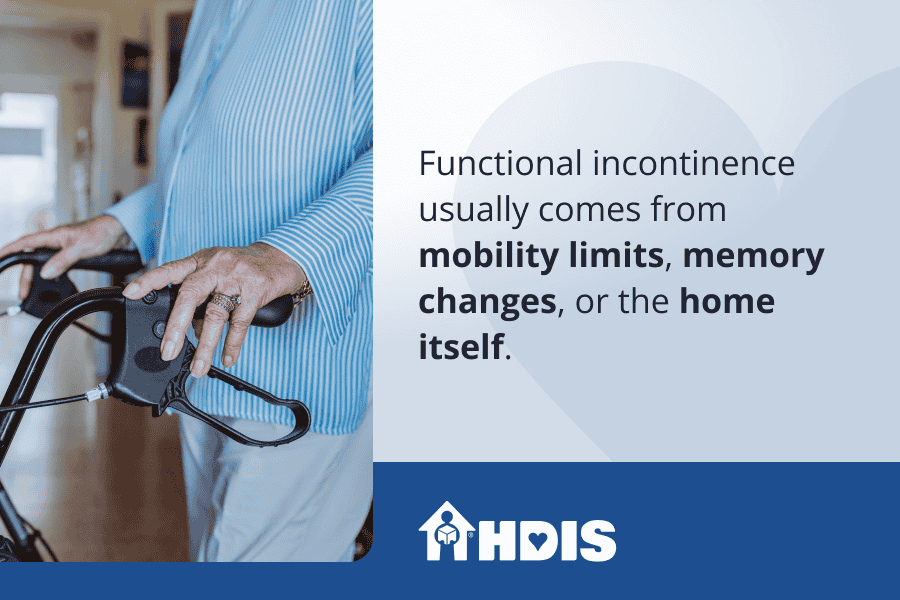
Mobility Issues
Arthritis, back pain, a stroke, or Parkinson's disease can make moving slow. If it takes too long to get up and walk to the bathroom, the person may not make it in time.
Think of moving the person closer to the bathroom, allow extra time, and have protection in place for the moments movement is too slow.
Cognition Problems
Alzheimer's disease, Lewy body dementia, and Huntington’s disease affect memory and thinking.
The person may:
- Not notice the urge to go
- Feel restless
- Tug at their clothing without knowing why
- Forget where the bathroom is
- Head for the bathroom and get distracted on the way
Some sedating medications can make the situation even worse.
Memory changes usually can't be reversed, but a set routine, gentle reminders, and reliable protection can relieve the situation.
Environment Barriers
Sometimes the obstacles may be the home itself: a bathroom may be down a dark hallway, a corridor may be crowded with furniture, or a toilet may sit too low to use it quickly.
The good news is that these issues are the quickest to fix.
Home Adaptations That Help
To help with functional incontinence, you can make a few practical changes to the home and the person’s daily routine.
Make the Bathroom Easy To Reach
Clear the path between the bed or chair and the toilet. Move away rugs, cords, and furniture that get in the way and can cause trips and falls.
Install grab bars beside the toilet and a raised toilet seat, so the person can sit down and get up quickly and safely.
For nighttime, use a bedside commode that can save a long walk down the hall.
Add Light
Many accidents and falls happen in the dark. Keep a light on in the bathroom at all times and add motion-activated night lights that switch on the moment the person steps into the hall.
Reflective tape on the floor can be extremely helpful for people who wake up disoriented.
Simplify Clothing
Buttons and zippers add seconds the person may not have. Choose clothing with elastic waistbands or easy closures like Velcro or magnetic fasteners.
It will allow the person in your care to undress quickly or accept help with less frustration.
Set a Toileting Routine
Set a regular schedule, encouraging the person to go to the bathroom about every two to three hours as well as after waking and meals and before bed.
Watch for signs the person needs to go, like restlessness or pulling at their clothing, and give a gentle reminder. Over time, you can slowly space the visits further apart.

When To Talk to a Doctor About Functional Urinary Incontinence
Functional incontinence is usually managed at home, but some changes are worth a doctor's attention. These can include:
- Leaking that starts suddenly or gets worse
- Pain, burning, or blood when passing urine
- More confusion than usual
- Constipation, or no urine passed in a long time
Often the cause can be a urinary tract infection, constipation, or a medication side effect.
A doctor can rule these out and confirm what is behind the changes.
HDIS: The Right Protective Products for Caregivers
Getting protection right matters more when you are choosing it for someone else. HDIS makes that part simple and friendly.
For 40 years, we’ve helped family and professional caregivers find what works, whether they are supporting a parent with dementia, a client recovering from a stroke, or a resident with mobility issues.
Our range of products covers every kind of incontinence protection, from tab-style adult briefs and protective underwear to booster pads, pads and liners, and overnight underpads.
Not sure which product fits? Our team can help you weigh up size, absorbency, and style for the person you care for.
Many members qualify for 100% Medicaid-covered supplies, and the paperwork is handled directly with the doctor and Medicaid plan.
You get room to change your mind. Unopened packages come back for a full, no-questions-asked refund if the fit is not right.
And if you want one less thing to track on your busy day, a monthly subscription delivers supplies on schedule, so you are never caught short on a hard day.
Functional Incontinence: FAQs
What is functional urinary incontinence?
It’s urine leakage that occurs because a person cannot get to or use the toilet in time due to mobility limitations, mental or memory issues, or environmental barriers.
How is functional incontinence different from urge incontinence?
With urge incontinence, the bladder sends a sudden, powerful signal that is hard to hold. With functional incontinence, the signal is normal, but the person cannot act on it on time.
Can functional urinary incontinence be treated?
It is usually managed rather than cured, since the condition is caused by barriers outside the bladder. Consider home changes, a toileting routine, and the right protection. If you need advice on the products and size, our friendly product experts can talk you through the details, so the first order is the right one.
What protection works best for a person with limited mobility?
For someone with limited mobility or bedside care, tab-style briefs and underpads are usually the easiest to manage. For someone still walking to the toilet with help, protective underwear supports independence. Our team can help match products to the person's needs.




Getting Started
Discount for Personalized Delivery Plan: No more browsing the incontinence aisle at your local drug store. Receive a 5% discount, and your products arrive on your schedule.